Native species — Introduced
Astacus leptodactylus
 racul-de-lac
 Narrow-clawed Crayfish
 Galizischer Sumpfkrebs
 écrevisse à pattes grêlesracul-de-lacNarrow-clawed CrayfishGalizischer Sumpfkrebsécrevisse à pattes grêles
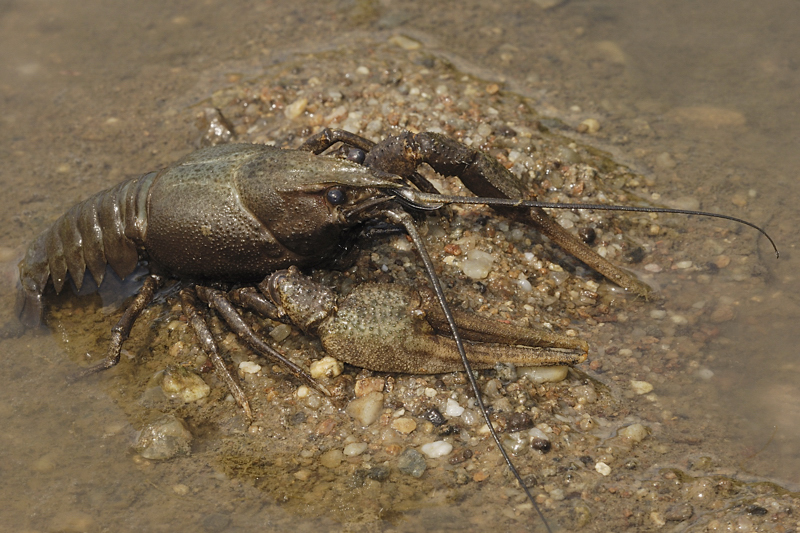
Large and robust crayfish, adults frequently exceeding 14 cm in total length. The dorsal colour of the carapace ranges from yellowish-brown to dark brownish-black depending on the time since last moulting, age, and habitat. The ventral side is lighter, tending towards dirty white. The rostrum has parallel, strong, denticulate margins with a distinct median keel. The apex is long and sharp. There are two postorbital ridges each terminating in a spine. A strong spine is present at the base of the antennal scale. The cervical groove and the margins of the cephalothorax bear spines. The claws resemble forceps and are visibly longer in males; both the propodite and the dactylpodite are smooth with minor roughness on palpation. Occasionally the claws may appear sickle-shaped.
Native to the Ponto-Caspian region, today its range covers almost the entire European continent as a result of deliberate introductions to western Europe. It is absent from Spain, Portugal, Ireland, Norway, Sweden and most of Greece (Souty-Grosset et al. 2006). In Romania its distribution covers the lowland zone, present in large rivers, lakes, fish ponds, and canals. There are few places where the species can coexist with the Noble Crayfish (Astacus astacus). Following the invasion of the Spiny-cheek Crayfish (Faxonius limosus), the Narrow-clawed Crayfish frequently co-occurs with it in the Danube. For the distribution map, visit the distribution page.
Males typically have longer and stronger claws, and the abdomen is visibly broader in females. To precisely distinguish the sexes, especially in juveniles, examination of the sternal plate and pleopods is definitive. In males the first two pairs of pleopods are strong and oriented anteriorly (for spermatophore transfer), while in females all pleopods are equal. The shape of the first two male pleopods is an important criterion for distinguishing this species from similar ones: the first pleopod (Pl. I) has a distal lobe almost 1/2 of the total length, while the second pleopod (Pl. II) has an exopodite approximately equal in length to the endopodite, the distal lobe of the endopodite being approximately 1/2 of its length.
Lives in slow-running waters, lakes, fish ponds, and canals, finding shelter in earthen banks, submerged vegetation, or various objects in the water. It also tolerates brackish and even marine water. Active both day and night, consuming almost any food — a true sanitary of the waters. Adults consume submerged plants when animal food is unavailable. Occasionally leaves the water in search of food. Less sensitive to oxygen deficiency than native species; it can survive several days out of water at low temperatures. Like other crayfish it is very sensitive to chemical pollution. Natural predators include otter, muskrat, rat, mink, coypu, fox, badger, and water birds (for adults), and fish (for juveniles) — particularly wels catfish, pike, perch, and sturgeons. The oomycete Aphanomyces astaci, introduced to Europe with North American crayfish, causes crayfish plague, against which native species are highly vulnerable. Ectoparasitism without apparent damage is frequent, involving branchiobdellids, chironomids, and ostracods. Bivalve colonies (Dreissena sp.) are often attached to adults.
Narrow-clawed Crayfish mate in autumn, between October and December, when females carry white spermatophores on the sternal plate. The clutch is large, containing 180–600 eggs, and is carried by the female among the pleopods until juveniles become independent. Hatching success is 42–53% of the total clutch. Age can be estimated from total length: 0+ = 15–35 mm; 1+ = 38–50 mm; 2+ = 45–95 mm; 3+ = 86–112 mm; 4+ = 110–150 mm; 5+ = >155 mm. Moulting is more frequent in juveniles (up to 4–5 times per year); adults moult once or twice per year, between May and June. The days immediately following a moult are critical — without the hardened exoskeleton the crayfish is vulnerable to attack by fish or other crayfish. Lost or damaged appendages regenerate at the next moult, but a regrown claw is usually smaller. Males become reproductively mature at 60–70 mm and can fertilise eggs every year. Females begin laying eggs at 2–3 years of age.